Clannad (クラナド, Kuranado)
is a Japanese visual novel created by the software company Key, who also produced the successful titles Kanon and Air. Key announced in 2001 a release date of 2002 for Clannad and, after several postponements, finally released a limited version for the PC on April 28, 2004, and the regular version less than four months later on August 8, 2004.
The visual novel was later ported to the PlayStation 2 on February 23, 2006, and will be ported again to the PlayStation Portable in May 2008, along with the Xbox 360 in spring 2008. The gameplay in Clannad follows a linear plot line, which offers pre-determined scenarios and courses of interaction, and focuses on the appeal of the five female main characters. According to Jun Maeda, the main scenario writer of Clannad, the title means "family" or "clan" in Irish.
While both of Key's previous works, Kanon and Air, had been released first as adult games and then censored for the younger market like most bishōjo games, Clannad was released for all-ages; this led to a certain amount of disappointment among fans of Key's adult works. Partly in reaction to the disappointment, an adult sequel-of-sorts, Tomoyo After: It's a Wonderful Life, was released on November 25, 2005.
Clannad has made several transitions to other media: four manga series, the first serialized in the Japanese magazine Comic Rush, the second serialized in Comi Digi +, the third serialized in Dengeki G's Magazine, and the fourth in Dragon Age Pure; an animated movie by the animation studio Toei Animation released on September 15, 2007; two anime series by Kyoto Animation, which also animated the previous Key titles Air and Kanon; and, lastly, two sets of drama CDs, totaling nine in all.
Story
Tomoya Okazaki is a third year high school student who dislikes his life. Tomoya's mother (Atsuko) died when Tomoya was young, leaving his father (Naoyuki) to raise him. After the accident, Tomoya's father turned to alcohol and gambling, and held frequent fights with his son. One day, Naoyuki, again arguing with his son, slammed Tomoya against the wall, dislocating Tomoya's shoulder. Ever since then, his father has treated Tomoya nicely, but distantly, as if Tomoya and he were strangers rather than a family. This hurts Tomoya more than his previous relationship with his father, and the awkwardness of returning home leads Tomoya constantly to stay out all night. Additionally, the injury disables Tomoya from participating in his basketball club, and pushes him to distance himself from his school and other activities. Thus his delinquent life begins. Tomoya's good friend Youhei Sunohara, who got thrown out of the soccer club for a dispute, is also a delinquent and often hangs out in his dorm room with Tomoya doing nothing much.
At the beginning of the school year, Tomoya finds that his life is about to change when he chances upon Nagisa Furukawa, a soft-spoken girl one year older than him who is repeating her last year in high school due to being sick much of the previous year. Her goal is to join the drama club which she was unable to do due to her sickness, but they find that the drama club was disbanded after all the members graduated. Since Tomoya has a lot of time to kill, he starts to help Nagisa in reforming the drama club. During this period, Tomoya meets and hangs out with several other girls who he gets to know well and help with their individual problems.
In the second part of the story, which starts immediately after the end of the first part, but extends into the next ten years, Tomoya and Nagisa live together as a family. Tomoya has to endure several hardships that the family has been suffering from, mainly involving Nagisa's illness. However, just after Nagisa gave birth to their first child, Ushio, she dies, leaving Tomoya to fall into a state of depression which causes Nagisa's parents, Akio and Sanae to look after Ushio. Five years later, Tomoya meets Shino Okazaki, his grandmother on his father's side. Shino explains to Tomoya about his father's past and tragedy, similar to Tomoya's current situation after Nagisa's death. After hearing that, he decides to raise Ushio and acknowledge Naoyuki as his father. Unfortunately, Ushio is struck with the same disease as Nagisa not long after this event. In the coming winter, wanting to do anything for Ushio, Tomoya brings Ushio for a trip, but Ushio fell unconscious and dies shortly after, and presumably Tomoya dies. Wanting to save themselves from this tragic fate, Ushio becomes the girl in the illusionary world, calling garbage doll (Tomoya) to collect the happiness around the city to create a miracle and save Nagisa and themselves.
Tomoya's psychology is further developed in his dreams of a bleak world. In the first few dreams of that kind, he sees a world which is devoid of all people except for one girl, whom is never shown in the original game but is spoken of (she is shown in the anime version). Each time he dreams, he finds out more about the world. Later on, Tomoya finds out that the girl has a special ability to fuse junk together to create new things, with which she creates a body for him. Thus he is reborn in this world, and fills time following the girl around. Tomoya conceives that only the two of them are "alive". To pass time, Tomoya and the girl try to build another doll with more junk they find, but as it has no soul, it fails to come to life. Eventually, winter sets in, and the girl becomes cold to the point where she cannot move any more. Remembering a distant world where he came from, Tomoya convinces the girl to build a ship so that the two can escape the winter and continue a happy life. However, their flight is doomed to meet tragedy.
故事大綱:
在某個小鎮,主角岡崎朋也因為家庭的因素成為不良少年。某一天,他在學校坡道前發現了一個止步不前的女孩,在朋也認識了這個名為「古河渚」的女孩後,他的生活開始有了重大的變化。前半為主角和女主角們之間所發生的事件,後半After story為主角和古河渚共同生活的日子,其中還穿插了不可解的幻想世界,CLANNAD就是由這三個要素所組成的故事。
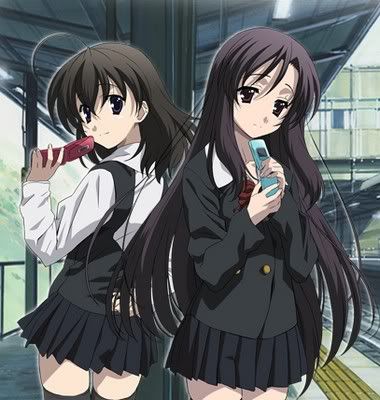
CLANNAD動畫作的進度好像跳太快了,第一話從頭看到尾都是跳畫面啊,相信有玩GAME的人應該都看不慣,蠻多地方沒玩過原作的人大概也會被搞得霧煞煞,就例如中間突然插入的幻想世界,只希望京都尼之後會作好些,像是岡崎朋也與古河渚相見的畫面就感覺是用跳的,小渚說了「あんぱん」,那時候真覺得她真的蠻呆的XD。後面的春原依然還是在搞笑啊,朋也一看到就是被橄欖球隊員給痛宰一頓的畫面,春原依舊喜歡說大話,還好有個朋友喜歡對他吐嘈,嗚啊,才剛第一話朋也許多吐嘈的地方就被去掉了。還有差點忘記說那個厲害的宿舍管理員美佐枝了,雪野配音的她還真的有出來感覺。接下來出現的就是藤林姊妹花了,真的很像是らき☆すた的柊家姊妹,姊姊是個傲嬌(?) ,妹妹算是冒失鬼屬性(?),當然這邊最棒的應該是杏丟飛過來的辭典了吧,我真想知道她到底有多少辭典可以讓她丟。
接下來又跳跳跳...跳到了智代懲惡的地方,智代的連踢真的是超帥的,那幾個暴走族被打得飛起來的畫面用照智代的鏡頭跟用觀眾的視點真的差好多,還是前者比較棒,後者讓人摸不著頭緒地一致性認為太強了,不過這邊的場景好像只是拿來搞角色出場用的,那個不怕死跟愛打嘴砲的春原跟遊戲一樣,跑去跟智代挑戰,當然是一腳被K爆了。最要說的就是朋也也太快就到古河麵包店了吧,遊戲也要過很久才會到這邊啊,這就是所謂朋也快速攻略法?遇到了那有點無里頭的古河家族,早苗因朋也的毒蛇吐嘈淚奔了出去,早苗不要哭啊,後來朋也就遭到秋生的警告了,哈哈。說起來這家還真奇怪,似乎不會那麼記仇,秋生、早苗跟朋也的對話還蠻GJ的,最要說的就是那段隨便幫別人改名字的地方-大宇宙銀河,我還超銀河大O蓮勒。就這樣看下去,感覺這次京都尼做得還不錯,感覺有做出來,人物也沒有崩壞,是個值得期待的好作品,說起來悲哀,野中藍好萌要下一話才會登場啊,拿著她奇怪的雕刻星星嗎?(幸運星?)預告的地方光是聽到她的聲音就感覺很興奮了XD。
OP是遊戲的OP,說起來不管是A.I.R或是KANON,京都尼還真是忠於原作,MV的部分做得還真是不錯,有跟OP合到,一個MV就把基本主要角色給介紹完了。至於ED的話,是之前沒聽過的團子大家族有歌詞版,MV是一堆團子的大家族,真的是好溫馨、好可愛啊,似乎有人因為這ED讓眼睛流汗了,我是沒有啦(毆)。這次京都作的OP跟ED在KANON特典中出來,雖然在撥出之前就都看過聽過了,不過真的是值得一看再看啊XD.


__THISRES__157598%5B1%5D.jpg)


__THISRES__128037.jpg)